
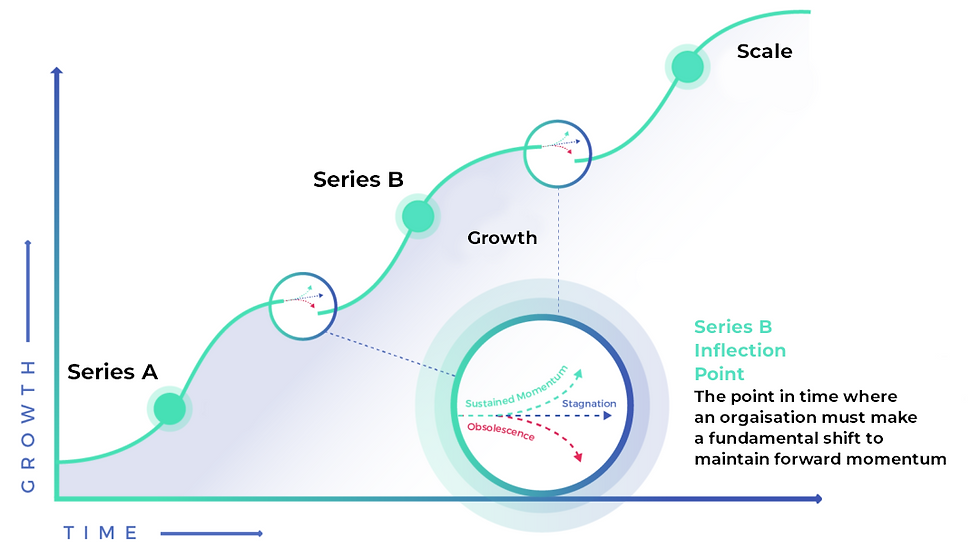
The Series B Inflection Point

Undervaluing Significant Risk
Every Series B investment committee scrutinises ARR growth, net revenue retention, CAC payback, and the competitive landscape. The best ones probe the founders hard, and many run reference checks on the leadership team. Far fewer run a rigorous assessment of the leadership team itself: the structural, cultural and strategic architecture asked to absorb a large capital injection and scale at pace.
We think that undervalues a significant risk.
Academic research into venture capital returns has found that on average, seven out of ten portfolio companies will not return the capital invested in them.
The causes of underperformance are many, and organisational factors remain among the most underweighted in investment decision-making: leadership trajectory, cultural breakdown, strategic decoupling, and the work of evolving from a scrappy early-stage team into a functioning company. All of them correlate directly to who is running the show.
The data is stark. Research into B2B SaaS companies, among the most well-funded startup categories, found that approximately 68% of teams fail to evolve for sustained growth at scale, their startup-era operations proving fundamentally inadequate for managing larger, more complex organisations.
Investors who diagnose and actively manage the organisational and leadership layers of their portfolio, alongside the commercial one, generate stronger returns, reduce downside exposure, and build more exit-ready businesses.
At Activate Human Capital, we make that work rigorous and repeatable. The leadership team is the upstream driver of organisational performance, we read it intentionally.
What We Measure
We built our framework to answer a single question an investment committee can struggle to answer: is this organisation capable of becoming what the investment needs it to be?
Our Leadership Architecture Index describes the executive team across five dimensions. Each one sits upstream of commercial performance representing a distinct category of hidden exposure.
Strategic Focus: whether leadership attention concentrates on the highest-value priorities, and whether the market read stays current rather than defending a founding narrative.
Decision Velocity: whether decisions flow through the organisation at the speed scale demands.
Leadership Capacity: whether the leadership layer can lead the next stage of growth, ahead of the curve.
Conflict Intelligence: whether the team surfaces and resolves disagreement productively, rather than accumulating it as cultural debt.
Role Design: whether the structure of the leadership team keeps pace with its growing complexity.
The index carries a sequencing principle as well as a set of measures.
Our free Activate Scorecard reads these same five dimensions in under five minutes, at activatehc.com/leadership-scorecard.
The 5 Dimensions - Strategic Focus
This sits high in the causal chain. Market conditions, competitive dynamics, regulatory shifts and technological disruption create the pressure that calls for strategic and organisational adaptation. The dimension measures whether leadership attention follows that pressure to the highest-value priorities.
The question is whether the executive team has formally revisited its market assumptions, and whether their strategic decisions follow that updated analysis.
Diagnostic questions we explore:
Has the management team formally mapped changes in the competitive and regulatory environment since the Series A thesis was written?
Do strategic decisions follow current market intelligence, or the inertia of a founding narrative?
What is the mechanism by which market signals reach the leadership team, and how quickly does the organisation respond?
Does leadership attention concentrate on the highest-value priorities?
The 5 Dimensions - Decision Velocity
The Series B round is fundamentally a bet that a working machine can be fueled to expand. The investor underwrites a strategy; the organisation has to execute it. Decision Velocity measures whether that execution flows through the organisation, or otherwise due to every consequential call routing back to one person.
In rapidly scaling companies, the founder-decision bottleneck is faster than most founders anticipate. At 30 people, the strategy travels through daily proximity. At 150 people, that transmission mechanism has run its course, and something more deliberate has yet to replace it.
Diagnostic questions we explore:
Can the leadership team make consequential trade-offs autonomously, in service of the strategy, with the founder out of the room?
Do operational decisions at team level serve the stated strategy, or short-term metrics?
Where do decisions queue, and what is the cost of that delay to the value creation plan?
Dozens of Series B companies simply plateau rather than collapse, due to what might be called the founder-decision bottleneck: a growth-stage business in which decision making is still effectively a solo performance. The founder holds the strategy, articulates it at board meetings, and makes consequential decisions accordingly. But the leadership team below cannot articulate strategy consistently, cannot make trade-offs autonomously in its service, and cannot transmit it to a workforce that is doubling in headcount every 12 months.
The 5 Dimensions - Leadership Capacity
Leadership Capacity measures whether this layer can build the organisation and whether the founders hold self-awareness and adaptability to evolve their roles as the business scales.
At Series B, the leadership layer is typically being constructed in real time: first VP of Sales, first CFO, first Head of People. The choices made in this 12 to 18 month window compound over the life of the investment.
Diagnostic questions we explore:
Is the leadership team being developed to lead the company through Series C and beyond, or does it still operate with Series A habits and bandwidth?
Does the founder hold the self-awareness to identify the aspects of their role that need to evolve, and the support to do so?
Are critical senior hires being made proactively, ahead of the growth curve, or reactively, in response to failure?
What leadership development infrastructure exists, and is it proportionate to the rate of headcount growth?
At Series B the assessment is not just the quality of the current leadership, but its trajectory, whether it is developing ahead of the growth curve or running to stand still. Those who get this right move from startup to scale-up. Those who do not, find that the same leadership behaviours that built the company begin to constrain it.
The 5 Dimensions - Conflict Intelligence
Conflict Intelligence measures whether a leadership team surfaces and resolves disagreement productively. The way a team handles disagreement is the earliest honest signal of how it will manage at scale.
Teams that bring conflict into open, structured debate resolve it. Teams that work around it build cultural debt that leads to elevated attrition, declining engagement, and the slow erosion of execution quality.
The cost of getting this wrong is measurable.
Diagnostic questions we explore:
When this leadership team last disagreed on something that mattered, did the conflict surface in the open?
Does more than one leader raise the difficult point, or does the team rely on a single voice for candour?
How does the team behave after a missed target: collective ownership, or a pivot toward blame?
The 5 Dimensions - Role Design
Role Design measures whether the structure of the organisation keeps pace with rapid scaling. It is the hardest of the five dimensions to assess in diligence and potentially the most consequential.
At early stages, structure and culture are effectively the founder's personality and habits, transmitted through direct contact with a small team. This works well for 20 people but not so much by 150.
Rapid hiring at Series B, often two to three times headcount within 12 to 18 months, creates a dilution effect:
new hires outnumber culturally embedded employees
Implicit norms travel less reliably
behaviours detach from values
This surfaces in attrition, declining engagement and execution quality. Role Design is a value creation lever.
Diagnostic questions we explore:
Is the company's culture actively nurtured as headcount scales?
Could a new hire joining today absorb the culture through their day-to-day experience?
What are the measurable indicators (retention, employee NPS, promotion rates, time-to-value), and are they tracked systematically?
Is cultural data shared as regularly as commercial data?
Next Steps
Every high-performing leadership team has one thing in common: someone chose to look closely. The next step is a 30-minute conversation. You bring the portfolio context and the leadership questions that matter most. We bring the framework and decades of experience reading teams under pressure. Together we decide whether a Leadership Due Diligence engagement is the right instrument for this investment.
The conversation earns its place on its own. You will leave with a clearer view of where your organisational and leadership risk sits, what to prioritise, and what to watch for.
Start the conversation
Contact us now to arrange a free 30-minute discovery call to talk through your portfolio company, the investment context, and the leadership questions that most need answers.
Here we decide together whether a Leadership Due Diligence engagement fits.


Comments